スカラー3重積の定義・性質・例題・平行六面体について
スカラー3重積
\[ \mathbf{a} \cdot (\mathbf{b} \times \mathbf{c}) \]
ここで、\(\mathbf{b} \times \mathbf{c}\) はベクトル \(\mathbf{b}\) と \(\mathbf{c}\) の外積であり、その結果得られるベクトルは \(\mathbf{b}\) と \(\mathbf{c}\) 両方に垂直なベクトルです。次に、このベクトルと \(\mathbf{a}\) の内積をとりす。

スカラー3重積の成分の計算
スカラー三重積 \(\mathbf{a} \cdot (\mathbf{b} \times \mathbf{c})\) を成分を用いて計算する方法を説明します。まず、ベクトル \(\mathbf{a}\), \(\mathbf{b}\), \(\mathbf{c}\) の成分を以下のように設定します。
\[ \mathbf{a} = (a_1, a_2, a_3), \quad \mathbf{b} = (b_1, b_2, b_3), \quad \mathbf{c} = (c_1, c_2, c_3) \]
ステップ 1: 外積 \(\mathbf{b} \times \mathbf{c}\) の計算
ベクトルの外積は、次のように計算されます。
\[ \mathbf{b} \times \mathbf{c} = \left( b_2 c_3 - b_3 c_2, b_3 c_1 - b_1 c_3, b_1 c_2 - b_2 c_1 \right) \]
ステップ 2: 内積 \(\mathbf{a} \cdot (\mathbf{b} \times \mathbf{c})\) の計算
外積の結果を用いて内積を計算します。
\[ \mathbf{a} \cdot (\mathbf{b} \times \mathbf{c}) = a_1 (b_2 c_3 - b_3 c_2) + a_2 (b_3 c_1 - b_1 c_3) + a_3 (b_1 c_2 - b_2 c_1) \]
スカラー3重積の計算問題
問題
ベクトル \(\mathbf{a}\), \(\mathbf{b}\), そして \(\mathbf{c}\) が以下のように与えられている場合、スカラー三重積 \(\mathbf{a} \cdot (\mathbf{b} \times \mathbf{c})\) を計算せよ。
\[ \mathbf{a} = (2, 3, -1), \quad \mathbf{b} = (1, 0, 4), \quad \mathbf{c} = (-1, 5, 2) \]
まず、$\mathbf{b} $と $\mathbf{c}$の外積を計算すると、
$\mathbf{b} \times \mathbf{c}$
$=
\begin{bmatrix}
2\times 0 – 4\times 5 \\
-1 \times 4 – 1 \times 2 \\
1\times 5 -0 \times (-1) \\
\end{bmatrix}$
$=
\begin{bmatrix}
-20 \\
-6 \\
5 \\
\end{bmatrix}$
次に内積を計算する。
$\mathbf{a} \cdot (\mathbf{b} \times \mathbf{c})=
\begin{bmatrix}
2 \\
3 \\
-1 \\
\end{bmatrix}
\cdot
\begin{bmatrix}
-20 \\
-6 \\
5 \\
\end{bmatrix}$
$= -63 $
行列式を用いる方法
\[ \mathbf{a} \cdot (\mathbf{b} \times \mathbf{c}) = \text{det}\begin{pmatrix} a_1 & a_2 & a_3 \\ b_1 & b_2 & b_3 \\ c_1 & c_2 & c_3 \end{pmatrix} \]
この行列式は、ベクトル \(\mathbf{a}\), \(\mathbf{b}\), \(\mathbf{c}\) の各成分からなる \(3 \times 3\) 行列の行列式です。
平行六面体
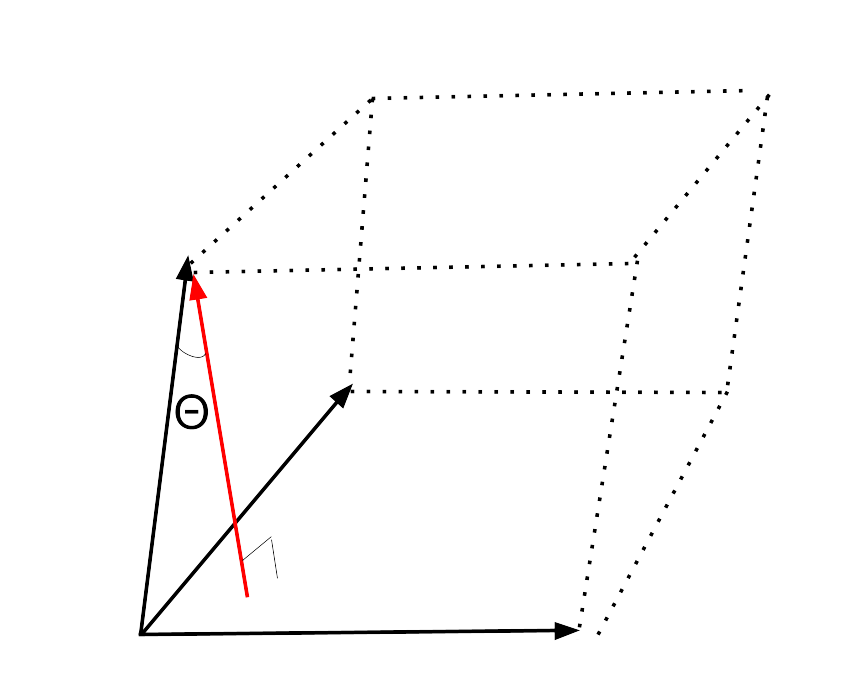
$$V=|\mathbf{a}\cdot ( \mathbf{b} \times \mathbf{c})|$$

平行六面体になる証明
図のように$0<\theta\leq \dfrac{\pi}{2}$とする。底面の面積をAとすると、
$$A=|\mathbf{b} \times \mathbf{c}|$$
とあらわすことができる。そして、高さを$h$とすると、
$$h=|\mathbf{a}|\cos\theta$$
とあらわすことができる。
したがって、体積$V$は
$$V=Ah$$
$$=|\mathbf{b} \times \mathbf{c}||\mathbf{a}|\cos\theta$$
$$=\mathbf{a}\cdot (\mathbf{b} \times \mathbf{c})$$
となる。
$\dfrac{\pi}{2}<\theta\leq \pi$のとき、体積は負になるので、
$$V=|\mathbf{a}\cdot( \mathbf{b} \times \mathbf{c})|$$
となる。